pulsar
titan · family 1 of 4
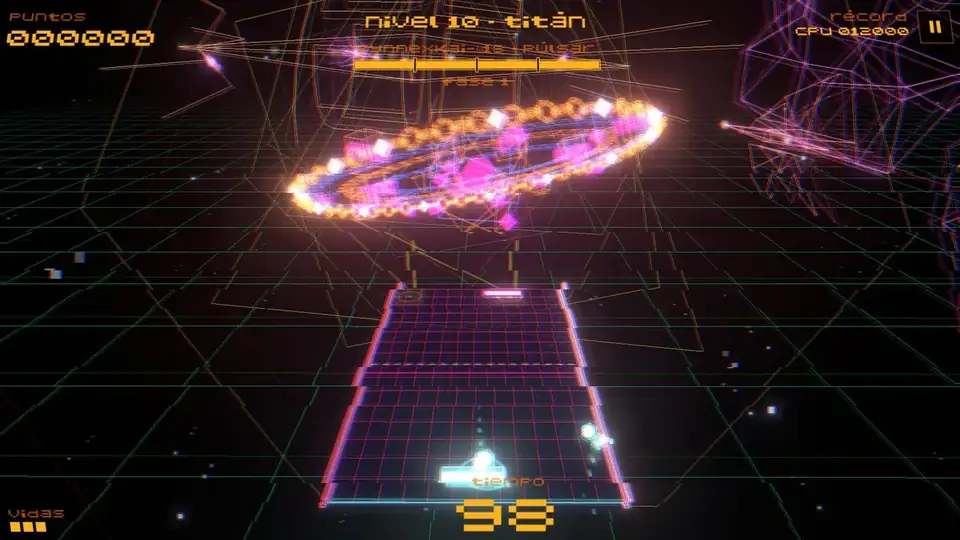
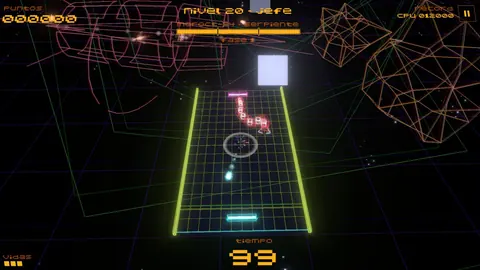
The pulsar is one of the four titan families in Asteroid Pong: a strange core locked inside 2 to 4 giant rings mounted like a gyroscope. It floats behind the rival goal, and to hurt it you send the ball through the lanes with a reticle, break its sweeper rings and close each stage with a finisher.
What the pulsar is
The pulsar is a titan: the biggest enemy in the game, which replaces the boss every ten levels. It is family 1 of 4 and has a single form, but every run builds its parts anew.
- Core: a torus knot, a Möbius strip, a finned lens, a petal corolla or a compound of cubes and tetrahedra.
- Rings: 2 to 4, made of plates, teeth, links, polygons or steps.
- Mount: gimbal, armillary or Saturn-style.
It has 4 phases: 3 stages and the core. You break it from the outside in, from the outer ring to the heart.
How a titan fight works
You can't beat a titan with ordinary goals: it never reaches the table, so you have to send the ball through the reticle in its goal.
- Lanes with a reticle. Its goal is split into 5 lanes. 2 have a reticle (3 on easy), marked by a column of amber light. The reticles switch lanes every 7.5 s (5.5 s on hard) or when the weak point they target falls.
- Comet shot. If the ball goes in through a lane with a reticle, it turns into a comet that flies for 0.75 s into a weak point: it takes 1 life off it (2 with the giant ball) and gives you 150 points and 1 s on the clock. A goal through a lane without a reticle does no damage, and the game reminds you: aim for the reticle.
- Weak points. They pulse between fuchsia and white. Each stage has up to 3; the core is a single one with more life.
- Probes. Every so often it drops a probe onto the table. Break it with the ball before it leaves: it takes life off a weak point of the current stage.
- It catches your ball. If you shoot at its goal outside the reticle lanes and the ball passes close, most of the time it holds it for a moment (1.0 s on easy, 0.8 s on normal, 0.6 s on hard) and sends it back with spin, curving sideways. It then needs 7 to 15 s before it can do it again. It never touches the giant ball.
- Finishers. Breaking each stage opens a finisher, and when the core drops below 30% life the final finisher comes: perfect center = titan destroyed.
- Extra speed. Against a titan, the ball and the CPU are 15% faster.
What to break in each stage
Each stage has its own weak points; once you break them all, that part of the titan falls apart in a 2.4 s slow motion with a screen shake, and you move on to the next one.
| stage | weak point |
|---|---|
| stage 1 | outer ring nodes |
| stage 2 | hinges of the next ring |
| stage 3 | core nodes |
| core | heart |
Life on normal: each stage weak point takes 1 hit (2 from level 40). The core takes 4 at level 10, 5 at level 20, 6 at level 30 and 7 at level 40. On easy life is multiplied by 0.7 and on hard by 1.15, rounded and never below 1.
Probe: the sweeper ring
The pulsar drops a sweeper ring onto the table: a wheel that rolls from wall to wall and bounces the ball. Break it and you take 1 life off a weak point.
- life
- 2 hits on easy, 3 on normal and hard
- speed
- faster on each difficulty
- lasts
- 12 s on easy, 10 s on normal and hard
- damage to the titan
- 1
- points
- 400
It drops one batch at a time: the first at 9 s, then 11 to 15 s after the previous one ends (a bit more spaced out on easy). If you don't break it in time, it shoots at you once and goes back to the titan.
How to beat the pulsar
- Aim for the reticle. Watch for the amber light columns and send the ball down those lanes: every comet shot takes 1 life off a node.
- Break the sweeper ring. It rolls from wall to wall: read its path and hit it 3 times (2 on easy) before it leaves. Every broken ring takes life off a weak point.
- Don't waste shots outside the reticle. Near its goal it catches your ball and throws it back with a curve: if you shoot down a lane without a reticle, be ready to move.
- Stop the needle in the center. Every broken stage opens a finisher; at the core, a perfect final finisher destroys it in one go.
- Dodge the eclipse. At the core, when your row turns red, run to the only free gap: it always appears far from where you are.
Pulsar attacks
The pulsar adds one of its own attacks per stage: laser in stage 1, laser and burst in stage 2, and all three from stage 3. It also uses the tilted table from stage 2 and the vortex from stage 3. The final attack first comes 7 s into the core and repeats every 20 s (26 s on easy).
When it appears
The pulsar can be the titan of any level that is a multiple of 10: titans replace the boss every second boss.
- Campaign: levels 10, 20, 30, 40…
- Boss rush: the 2nd, 4th, 6th boss…, every other one.
- Different families: the 4 families are shuffled every run, so the first four titans (levels 10, 20, 30 and 40) are always from different families. After that the order repeats.
- Never in endless or 2 players.
- Web demo: the campaign goes up to level 10, the first titan, so you can meet it there.
The titan level lasts 99 s and goals don't count toward clearing it: it ends when the titan dies. The clock freezes during the intro, which lasts 6 s and can be skipped by holding for 0.9 s (tap, space, OK or A).
Size comparison
A titan measures 40 to 52 u, more than five times the width of the table. That's why it doesn't fit on it: it floats far away, behind the rival goal.
| what | size |
|---|---|
| table width | 9 u |
| your paddle | 2 u |
| regular boss | ~6 u |
| giant | 13–20 u |
| titan | 40–52 u |
| pulsar rings | radius 12 to ~24 u |
u = game units (the table is 9 × 16). The pulsar's rings reach about 48 u across. On a phone in portrait the titan moves up and back a little so it fits on screen.
Rewards
Beating a titan pays more than a regular boss.
- Points: double a boss: 10,000 at level 10, 20,000 at level 20, 30,000 at level 30. On top of that, 300 per weak point, 500 for the core, 400 per sweeper ring and 150 per comet shot.
- Coins: the ones from a boss (20 + 5 per 10 levels, plus the level's own) and 15 extra.
- Lives: +1, and another one if you lost no lives in the level (max 7).
- Titan radio: beating a titan unlocks the titan radio in the jukebox.
- Missions and achievements: it counts as a defeated boss, but not for the collector achievement (beat all 8 boss types).
When it dies it blows up in a 2.2 s chain of explosions and the titan defeated screen appears.
Music
Every titan has its own theme of epic drum n' bass and jungle, at 172–176 BPM, in Phrygian, natural minor or harmonic minor.
The theme is built in sections that follow the fight: the intro opens with big drums and low brass, every broken stage comes in with a kick, a cymbal and a brass hit, and the music moves to a new section until the core, where jungle and drum n' bass merge. Beating a titan unlocks the titan radio, which plays that theme on loop.
In the retro view
In the retro view, the pulsar is drawn from above, outside the table, with the same warnings in the same order as in 3D. There the vortex turns the table 90° and the game reframes so it stays playable.
Name and epithet
Every titan gets a name and an epithet made up for your run, shown on the intro card (warning · titan).
- Name: 2 or 3 syllables, -Ω and a number from 2 to 99, followed by the family. For example: zorkai-Ω17 · pulsar.
- Epithet: two random parts, like herald of the void, anvil of cold iron or beacon of a thousand orbits, followed by the family and 4 phases.
The Ω in the name is just style: titans are never a secret boss Ω.
Frequently asked questions
How do you damage the pulsar?
By sending the ball through a lane with a reticle in its goal: it turns into a comet that hits a weak point. Breaking its sweeper rings and landing finishers also takes life off it.
How do I dodge the pulsar's eclipse?
When the floor of your row turns red there is a single free gap, wider than your paddle and far from where you are. Run there: the hit lands after 2 s on normal.
What level does the pulsar appear on?
It can be the titan of any level that is a multiple of 10 (10, 20, 30…). The family is drawn every run and the first four titans are always from different families.
Related
 golemtitan · family 2 of 4
 bastiontitan · family 3 of 4
 hive mindtitan · family 4 of 4
 finishermechanic · bosses, giants and titans
Describes version 0.8.26 · 2026-10-09